How web agencies can earn more with AI visibility
How web agencies can earn more with AI visibility is not really a question about AI as a question about helping clients understand where they stand, what opportunities they are missing and how to turn new visibility channels into measurable business outcomes.
For years, most agency conversations around discoverability were connected to Google rankings, organic traffic, keywords, backlinks and content performance. Today, a potential customer may still search on Google but they may also ask ChatGPT for recommendations, use Perplexity to compare providers, read an AI Overview before clicking anything, or use another AI-powered tool to understand which product, service, or company is worth considering.
That means clients are already asking new questions:
“Does ChatGPT recommend us?”
“Are we visible in AI search?”
“Why does AI mention our competitors but not us?”
“Should we be doing something about this?”
Most clients will not use terms like AI visibility, GEO, AEO, or answer engine optimization – they will simply know that something is changing in how people find businesses online. Instead of searching, many users now ask and, instead of comparing ten blue links, they now read a generated answer. And when they don’t understand that change, they will turn to the people they already trust with their websites, content, SEO and digital presence: their agencies.
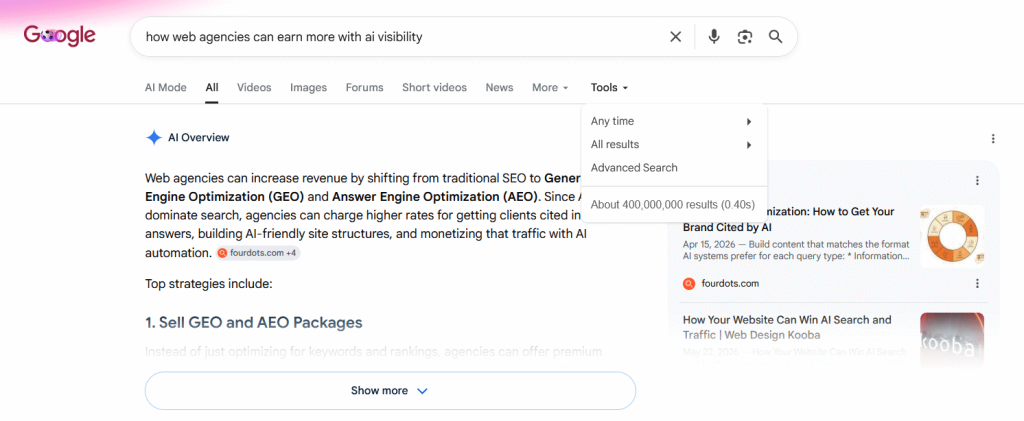
That is where the (still) brand new opportunity for agencies begins: in helping clients understand where they stand, what is missing and what can be improved. Like every major shift in digital marketing before it, AI visibility is creating a new category of services agencies can offer to clients.
Why AI visibility is becoming an agency opportunity
When social media became mainstream, businesses needed help understanding how to use it. When SEO became more complex and sophisticated, agencies were there to help companies navigate rankings, content and technical optimization. The same happened with analytics, conversion optimization, website performance.
AI visibility is following a similar path. What makes it especially important for agencies is that it often sits very close to the decision-making stage. When someone asks an AI tool to compare providers, recommend a solution, explain which product is best for a specific use case, or shortlist companies in a category, they are not just browsing but already evaluating options.
That means visibility in AI-generated answers is not only about being found but included in the moments where potential customers are forming opinions, comparing alternatives and deciding who deserves their attention next. For agencies, this creates a stronger business case as AI visibility becomes a way to help clients understand whether they are present in high-intent discovery moments.
What changed?
Traditional SEO focused on relatively clear metrics. An agency could show rankings for target keywords, track organic traffic growth, monitor click-through rates and identify opportunities for improvement. While SEO has always been more complex than rankings alone, businesses generally understood what success looked like.
AI-driven discovery introduces another layer where people are no longer limited to searching with keywords and reviewing a list of results. They can now ask complete questions, request recommendations, compare solutions and receive summarized answers without visiting multiple websites.
This presents a huge change in how information is discovered and presented.
Why?
A company may rank well for a keyword and still be absent from AI-generated recommendations. At the same time, another business (a competitor) may have limited organic visibility yet be consistently mentioned in AI-generated responses because its content is clear, authoritative and closely aligned with specific topics. And as a result, clients increasingly want to understand:
- How often their brand appears in AI-generated answers
- Whether competitors are being recommended more frequently
- Which topics are associated with their business
- Where potential visibility gaps exist
These are not replacements for SEO questions but their extensions and it’s precisely what creates a new service opportunity for web agencies.
The problem: You can’t improve what you can’t measure
Knowing all this, one of the biggest mistakes agencies can make is jumping directly to recommendations. Here’s a scenario:
A client hears about AI search and immediately wants to know what content to create. Another asks whether they should redesign their website. A third wants to launch an AI optimization initiative.
Before any of those decisions can be made, there are more important questions to answer:
- What does the current visibility actually look like? Without reliable visibility data, agencies are forced to make assumptions.
- Is the brand appearing in AI-generated responses?
- Which topics generate visibility?
- Which competitors appear more often?
- Where are the biggest gaps?
Unlike traditional search rankings, these answers are not always out there and obvious. Depending on the question being asked, the context of the conversation, the industry and the information available to AI systems, visibility may vary. That is why the right measurement is crucial and must-have in place if the agency plans to turn recommendations into a full service(s). Without it, those are merely assumptions. Which brings us to the next point.
Turning AI visibility into a service
How can agencies turn AI visibility into something more than an interesting trend? By reframing and transforming it into service, integrating it into something clients already understand.
AI Visibility audit
An AI visibility audit gives clients a starting point so that, rather than guessing how their brand appears across AI-powered experiences, businesses gain a clearer understanding of their current position, visibility strengths and potential weaknesses. For agencies, this creates an opportunity to start a larger strategic conversation.
Competitor visibility benchmark
Who doesn’t love comparing benchmarks and opportunities that lie within it? If competitors are consistently being recommended while the agency client is not, that information helps you identify gaps and prioritize improvements.
Benchmarking also makes AI visibility easier for clients to understand because it connects visibility directly to competitive positioning.
Monthly AI visibility reporting
Many agencies already report on traffic, rankings, conversions and website performance – AI visibility can become another layer of reporting.
Tracking AI visibility over time allows agencies to demonstrate progress, identify emerging opportunities and connect website improvements to broader discoverability goals.
AI visibility consulting
Data alone rarely changes anything because, as we know, the real value comes from interpretation.
Clients need someone to explain what these findings mean, which opportunities matter most, where effort should be invested first. This is where agencies move beyond reporting and into strategic consulting.
How agencies can deliver this efficiently
So, knowing all this and having it laid out with such clarity – there’s one more challenge to tackle: how can agencies deliver it consistently to earn more with AI visibility?
Checking a handful of prompts manually might work for a single client but it doesn’t work when you’re managing ten, twenty or fifty clients, each operating in a different industry, targeting different audiences and competing against different businesses.
To turn AI visibility into a real service, agencies need a way to move beyond assumptions and anecdotal observations. They need a way to understand where clients appear, where competitors appear, how visibility changes over time, which opportunities deserve attention and what needs to be done in order to meet the goal.
This is where Ceyo.ai, a B2B SaaS platform that specializes in Generative Engine Optimization (GEO) and Answer Engine Optimization (AEO) becomes an interesting ally. Rather than treating AI visibility as a collection of screenshots and manual searches, it helps agencies monitor and analyze how brands appear across AI-driven discovery experiences. Instead of asking “Do we think our client is visible?”, agencies can start answering questions with actual data.
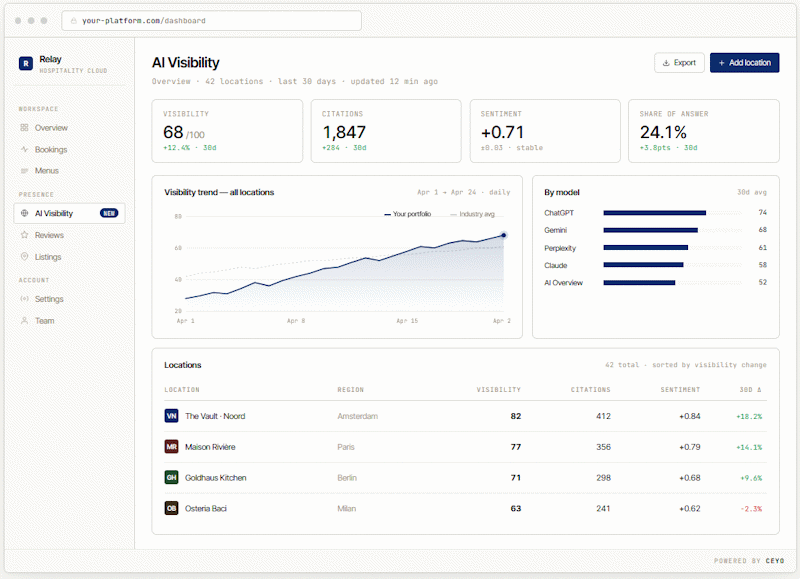
For example, imagine a client in the accounting industry wants to know whether their business appears when potential customers ask AI tools for bookkeeping recommendations. Another client may want to understand why competitors are consistently mentioned in AI-generated answers while they are not.
Without a dedicated visibility platform, answering those questions requires a significant amount of manual work and the results are often difficult to track over time. With a platform like Ceyo.ai, agencies can begin building a repeatable process around AI visibility; they can identify where clients are currently visible, compare visibility against competitors; uncover gaps and track changes as content, websites and marketing activities evolve.
Using this tool, agencies can turn these findings into a one-time AI visibility audit service. They can package competitor insights into a benchmarking report; include AI visibility tracking as part of an ongoing SEO or website care retainer. Or, use visibility gaps to justify content projects, landing page improvements and strategic recommendations. And more importantly, each of these services can be packaged and priced independently and white-labeled to be sent out to clients under their own brand.
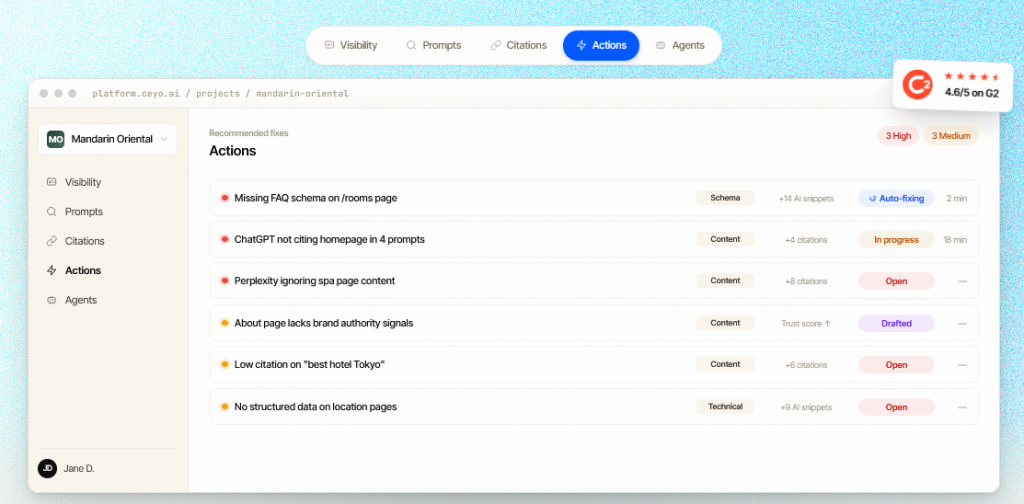
That way, clients are not paying for another dashboard but the agency’s expertise, interpretation and guidance. Ceyo.ai provides the data that makes those conversations more informed, while agencies provide the strategy that turns insights into action and it doesn’t stop there.
From AI visibility to agentic optimization
Once visibility gaps are identified, agencies need to understand what those gaps actually mean. Is a service page missing important context? Are competitors being associated with topics the client does not cover? Are there unanswered questions potential customers are asking before making a decision?
This is where Ceyo.ai goes beyond visibility tracking and more into an agentic optimization. How? By connecting visibility insights with actionable recommendations made by their AI agent, agencies can more easily identify content gaps, FAQ opportunities, missing service information and areas where website content may need to be expanded or clarified. Think of it as the platform’s system for analyzing AI search data and converting it into concrete, prioritized steps for your digital footprint and overall content improvements success.
Where page builders like WPBakery fit
Once opportunities are identified, agencies need to implement changes because visibility insights only become valuable when they lead to action and this is where the workflow moves from analysis to optimization.
Ceyo.ai helps agencies understand where visibility gaps exist, which topics competitors are being associated with and where clients may be missing opportunities to appear in AI-generated answers. Through its WordPress plugin, those insights can be brought closer to the website workflow, helping agencies connect visibility analysis with the pages, topics and content areas that may need attention.
If an agency discovers that a client is underrepresented for important topics, the next step is not another report but improving the website itself. That may involve expanding service pages, adding FAQs, restructuring content, creating dedicated landing pages or improving how information is presented throughout the site.
This is where WPBakery fits naturally into the process. Once you identify the opportunities, agencies can use WPBakery to update layouts, restructure pages, improve content presentation, create new landing pages and publish supporting content without introducing unnecessary complexity into the workflow.
Together, Ceyo.ai and WPBakery create a practical agency workflow: identify visibility gaps, uncover optimization opportunities, implement improvements and measure progress over time. Instead of treating AI visibility as a standalone report, agencies can turn insights into measurable website improvements that clients can see and understand.
Conclusion
If there is one takeaway from this article – AI visibility should not be treated as a standalone trend but as a service layer that helps clients understand where they stand today.
And, the agencies that earn more from AI visibility will not be the ones talking about AI the most but the ones that can consistently measure it, explain it and turn it into actionable recommendations for clients. To have a tool stack like Ceyo.ai backed with WPBakery building capabilities, for agencies looking to expand their service offers is a repeatable business opportunity.
The question is: will they use it?
Book an agency demo to see how Ceyo helps WordPress agencies turn AI visibility into a repeatable client service and share in our Community what you think of this tool.
