Web performance in 2026: Why fast websites still feel slow
What does web performance in 2026 mean and entails? If you say it’s all about speed – you’d be in the wrong, here’s why.
For a long time, web performance meant one thing: how fast does the page load? Developers measured server response time, total page weight, Time to First Byte – and if those numbers improved, the site was considered faster.
In 2026, that definition no longer holds. A page can be technically fast and still feel broken, unstable, or unresponsive to users. Which means the real question has shifted from:
How fast does the page load? → How good is the experience while it loads, and after it becomes interactive?
Cloud Bootcamp 2026: What Sabrina Zeidan’s opening session pointed
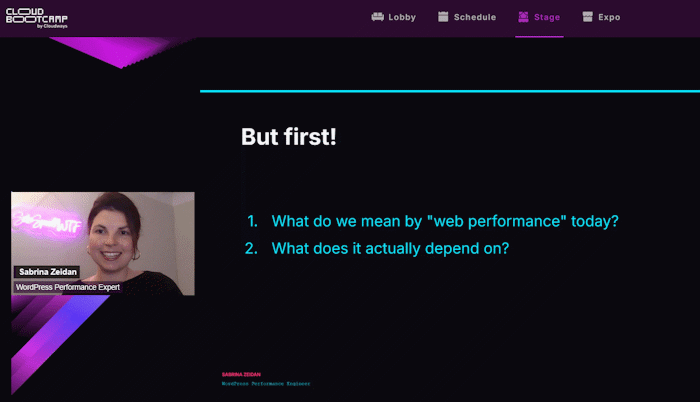
We attended Cloud Bootcamp by Cloudways, a two-day event focused entirely on web performance in 2026. The standout session was Sabrina Zeidan’s opening talk – State of Performance 2026: Why Speed Is Solved but Performance Isn’t – which framed the entire event around two deceptively simple questions:
- What do we actually mean by web performance today?
- What does it actually depend on?
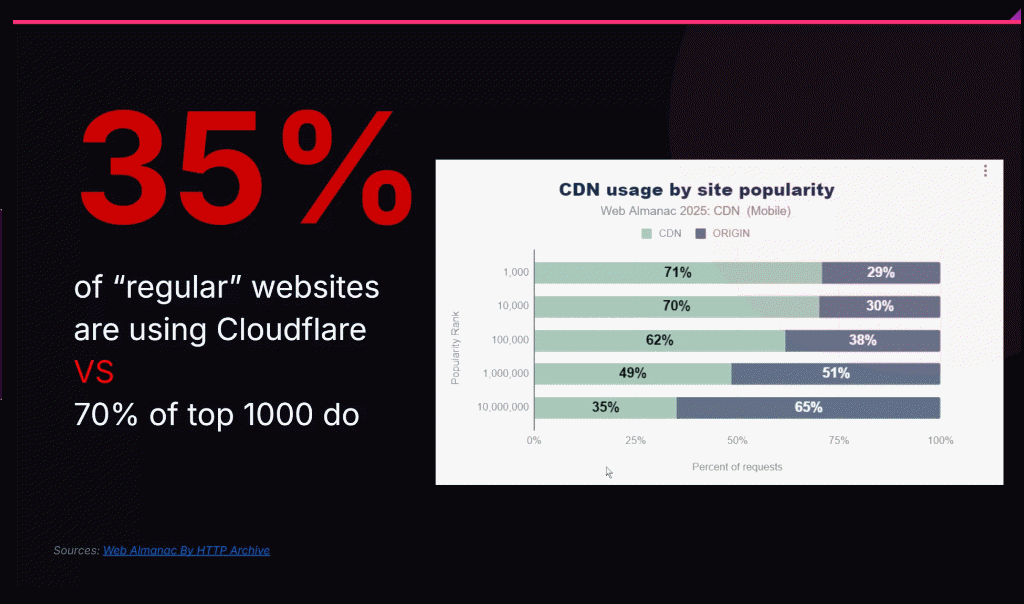
One of the most striking data points Sabrina shared came straight from the Web Almanac 2025 (HTTP Archive): only 35% of “regular” websites use Cloudflare, compared to 70% of the top 1,000 sites. The gap tells us a lot about where infrastructure investment concentrates – and why two sites can have very different performance realities even before a single line of code is written.
How the definition of web performance has shifted
Zeidan has walked us through the history in clear phases – and it maps almost exactly to how the industry’s tooling and priorities evolved:
| Year | How performance was defined | Primary metric |
|---|---|---|
| 2010 | Speed. If it loaded fast, it was fast. | Server response time, total page load time |
| 2015 | Perceived speed. When does it feel usable? | Time to First Byte, First Contentful Paint |
| 2020+ | Overall user experience. How does it feel throughout? | LCP, INP, CLS (Core Web Vitals) |
The 2020 shift is the one that mattered most. Google’s introduction of Core Web Vitals didn’t just add new metrics – it fundamentally changed what we’re measuring and we moved from delivery to experience.
LCP (Largest Contentful Paint) measures when the main content appears. CLS (Cumulative Layout Shift) measures whether the layout stays stable as things load. And INP (Interaction to Next Paint) – which replaced FID as a Core Web Vital in March 2024 – measures how quickly the page actually responds when someone clicks or taps something.
INP is the metric most WordPress sites are currently failing. It measures post-load responsiveness – something that no amount of image compression or caching configuration can fix if your JavaScript is blocking the main thread.
The 4 layers of every page load
The most practical takeaway that helps us understand web performance in 2026 is Sabrina’s 4 layers framework. Every page load is the product of four layers, working in sequence:
- Infrastructure – hosting, server response time, CDN configuration, caching layers. This is where TTFB lives.
- The website itself – how assets are managed, how scripts are loaded, how the theme and plugins interact with rendering.
- Tooling and debugging – how performance is actually measured, what tools are in use, whether the team can identify regressions before users do.
- The user – device capability, network speed, geographic distance from the server, browser.
Zeidan’s point was that most performance conversations jump straight to layer 1 – hosting speed, TTFB, CDN coverage – while the real problems for most WordPress sites sit in layer 2: scripts that load site-wide instead of conditionally, plugins that were installed for a feature that no longer exists, page builders generating bloated markup that keeps the browser busy long after the first byte arrived.
A faster server doesn’t fix a slow browser. That gap – between fast delivery and slow usability – is where most of today’s performance problems actually live.
For most WordPress sites, layer 2 is where the real work happens. It’s rarely the hosting and rarely the page builder – it’s everything that got added on top over time without a cleanup. A practical guide on speeding up WPBakery gets into the specifics, and if you want to see how the builder actually benchmarks against others, the WP Rocket test results are worth five minutes of your time.
What traditional speed metrics don’t show anymore
TTFB still matters. It tells you how quickly the server responded – which is the beginning of the story, not the end. A good TTFB with a poor INP score means your hosting is fine, but something in your JavaScript stack is blocking the main thread after load.
The browser’s job doesn’t end when the HTML arrives. It still needs to parse and execute scripts, calculate layout, paint pixels, and prepare the interface for interaction. On a script-heavy WordPress site – one with multiple analytics tags, chat widgets, marketing tools and a complex page builder – that work can take several seconds. During that time, the page may look loaded but feel frozen.
This is the gap that Core Web Vitals were designed to measure. And it’s why a score of 95 in a synthetic speed test can coexist with real users bouncing off a page that won’t respond to their clicks.
Where this leaves us
The infrastructure problems that dominated performance discussions ten years ago are largely solved for most sites. Modern hosting stacks, HTTP/3, edge CDNs and better caching have compressed the delivery gap significantly. The CDN data Zeidan cited makes this concrete: the top 1,000 sites have already solved infrastructure. The rest of us are catching up.
What hasn’t been solved – and what the 2026 conversation is really about – is what happens after delivery. How quickly meaningful content appears. Whether the layout shifts while images load. Whether the page responds instantly when a user clicks, or makes them wait while the main thread finishes its work.
That’s why a website can be technically fast and still feel slow. And that’s the shift shaping every honest performance conversation happening right now.
Source: Sabrina Zeidan, “State of Performance 2026: Why Speed Is Solved but Performance Isn’t” – Cloud Bootcamp by Cloudways, March 2026. CDN data sourced from Web Almanac 2025 (HTTP Archive).
