CloudFest 2026 recap takeaways
CloudFest 2026 was one of those events where, if you have anything and everything to do with the internet infrastructure, cloud computing and hosting industry, you simply needed to be there. We were and here are our main takeaways we all can learn so much from.
TL;DR – CloudFest 2026
- AI is no longer “cool feature” – focus is on how it runs in real infrastructure (cost, load, reliability)
- Security & compliance (NIS2, audits) = mandatory operations, not optional add-ons
- Infrastructure talk shifted to failure, recovery, observability – not features
- Enterprise expectations (docs, processes, security) are spilling into smaller companies
- WordPress/agency ecosystem is becoming part of hosting/cloud business conversation
- Most visible activity = meetings, partnerships, networking
- Real value of the event = who you meet, not what you hear
In short, Cloudfest 2026 consisted of people who run and work with and around the internet, who were trying to figure out what breaks next and how to stay ahead of it. From security and compliance, to infrastructure, expectations and – yes, AI, a lot have been said and discussed about and pointed to the harsh but factual fact:
Nobody cares about what your product or service can do, they care about what it solves in real workflows and scenarios. But, first things first, here’s our overall experience of the past 4 days attending this out-of-the-box industry conference.
CloudFest 2026 in numbers
With over 10,000 participants, 143 speakers across 175 sessions and 150 partners from 80+ countries, it was one of the most dynamic events in the technology calendar. Seeing it through the WordPress lens – it’s like having 3 to 5 WordCamp Europe events at the same time! The five tracks run throughout the entire festival – covering cybersecurity & compliance, data sovereignty & independence, AI & the future internet, business sustainability and thought leadership. Add to that:
- a dedicated WP Business & Agency Summit on day one for agencies, hosting companies and WordPress professionals,
- the Hackathon – a separate pre-event that became a CloudFest institution in its own right – that brought together 110 developers across 10 open-source projects before the main festival even opened its doors,
- a brand-new HackerSpace with live cybersecurity competitions, an expanded venue footprint,
- the fact that 73% of attendees were C-level or senior management,
and you start to understand why CloudFest is less of a conference and more of an industry moment.
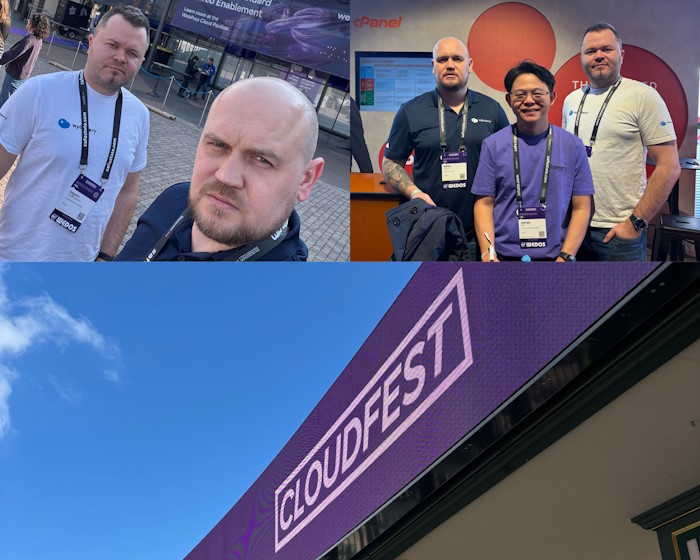
On easier note – we heard that, throughout the week, 10k gallons of beer were consumed* and more than 60 servers were thrown** – which made this conference that much more interesting, for sure.
Security is no longer a feature – it’s the floor
Security is no longer a feature – it’s a process you must prove. And we’ve covered this a bit in one of our previous articles, talking about 2026 WordPress security best practices.
As shared across stages and throughout the whole event, security today is the baseline expectation. There were multiple booths focusing on security, not only on the software side but also hardware. Earlier the same month, CloudFest published a piece on their official blog titled “82% of Cloud Workloads Are Vulnerable – Are You a Sitting Duck?”, that has set the tone for everything that followed and sparked many debates over the tooling used, contextual accuracy and the structural reality it reflects. Cyber Security Mag did an excellent breakdown on that for you to go through.
Data sovereignty & control
In 2026 and moving forward, things that matter are: where data lives, who owns it, how it’s accessed (especially relevant for EU providers). The shift in discussion we are seeing is from performance + price to control + compliance + auditability.
Digital sovereignty (the ability of individuals, organizations and nations to control their own digital destinies, including data, technology and infrastructure) is still often misunderstood. It’s not about the desire to block or replace global platforms but control and hold accountable when and where needed. Conversation was going around who has authority when systems are under pressure, where does the data sit legally, what other jurisdictions have access to it. Bottom line, autonomy needs to be safeguarded, critical assets need control and exposure to external shocks needs to be reduced. Companies and providers who can ensure that are the ones winning deals, as simple as that.
AI is real and it’s here to stay
Beyond just being a buzz word or a latest trend, the conversations shifted from AI is coming to how we use it in ops, infra, support. We know a thing or two around it – as we have developed an AI assistant that helps you create and maintain content on your site with more ease. Apart from that, what people care about today is:
- Automation in hosting ops
- AI in support + ticket reduction
- AI infra requirements (GPU, storage, scaling)
On that last point – the rapid growth of AI is transforming the architecture of modern data centers: as AI workloads scale across industries – organizations and businesses require infrastructure that is capable of supporting accelerated computing, high-throughput storage and massive data processing.
Overall, all this talk about AI can be summed into 2 directions: infrastructure that powers AI and infrastructure powered by AI. As for WordPress, the question is…. Should AI agents live in WordPress or with the host? If the agent lives in WordPress, it understands the website. If it lives with the host, it can understand the website plus the infrastructure around it. The second option gives it a wider operating range, especially for technical tasks like performance, environment management and multi-site operations. That said, it also depends on what permissions the host exposes. A host-level agent is only truly “broader” if it can actually act on infrastructure services, not just talk about them. What do you think?
And, one thing was quite noticeable (by our Head of Development, Edgars Veidenbaums): it was hard to find a booth that didn’t mention AI.

CloudFest 2026 actionable tips
As the final takeaways, here are a few straightforward tips and recommendations we think you’ll find useful.
If you’re in marketing, stop selling features and start showing how things actually work – in real workflows, real scenarios and in ways that reduce complexity. Lean into performance proof, real use cases and operational clarity instead of generic claims.
If you’re building a product, a service or content, talk more about what actually happens in practice: what breaks, how you solved it and what changed after. That’s the level of detail that makes things believable and usable.
And if you’re planning to attend CloudFest next time, don’t overbook sessions. Leave space for random conversations and prioritize side events, small group talks and hallway chats – that’s where most of the value actually happens.
Final note
Overall, attending CloudFest 2026 turned out to be beneficial in more ways than one. From meeting old friends, partners and clients from WordPress space to experiencing people and businesses outside our usual industry, we came home full of knowledge, valuable insights and topics to work around in the future. If interested in our page builder, make sure to keep track of our features to see addons and improvements we’ll be making. As the final takeaway, we leave you with this point made by our Head of Product, Raitis Sevelis:
“Visiting CloudFest with 10,000 attendees and exhibitors opens doors to new partnerships that are expected to result in customer-oriented innovations within our ecosystem.”
*+** Made up numbers, just for fun
