From WP Credits to WordCamp: The first university thesis focused on WordCamp participation
What drives WordCamp participation and what holds people back? Here are insights from the first university thesis developed within the WordPress Credits program.
WPBakery joining the WP Credits program at the end of 2025 had one clear goal: support WordPress education in a practical way and help students move closer to real contribution. That meant contributing mentor time, offering free WPBakery licenses as an optional learning tool and supporting a program built around structured learning, hands-on work and participation in the WordPress ecosystem. Now, that support is taking shape in a new and very specific way.
Kenny James Kuruvilla, a business administration student at Riga Nordic University and a participant in WordPress Credits program, is currently developing what is shaping up to be the first university thesis focused specifically on WordCamp participation. The topic is not about WordPress in general as is about what drives people to participate in WordCamp events, what holds them back and how participation can be made more accessible, especially for students and first-time attendees.
Instead of it being academic research written from a distance, it is research developing alongside real exposure to the WordPress community, real conversations with contributors and real event participation. Here’s how.
From classroom to WordPress community
Kenny’s path into WordPress started the way it probably starts for many students: in the classroom. Through an e-commerce course at Riga Nordic University, he was introduced to WordPress and given access to WPBakery as part of the learning process. At that point, WordPress was simply a tool used to complete a task. But that initial exposure opened the door to something much bigger. With guidance from Raitis Sevelis, who bridges both academia and product as a lecturer and Head of Product at WPBakery, that starting point turned into deeper involvement with WP Credits and the broader WordPress ecosystem. As he said himself:
“My curiosity started growing. I began exploring more, asking questions, trying to understand what was behind all this. With guidance from my lecturer, Raitis Sevelis, I started to realize something important. WordPress was not just a tool. It had a whole community behind it. A global one. People building, contributing, helping each other.”
The question behind the thesis
This path ultimately sparked Kenny’s interest and shaped his thesis around one concrete question: why do people who could benefit from WordCamp participation still hold back?
Based on his work so far, the barriers are not so much surprising, as they are important to be named clearly.
Starting with perception, as many people still see WordPress as a space mainly for developers, which makes students from business, marketing, design, or other non-technical backgrounds less likely to picture themselves inside that world.
Another is awareness because, even when interest exists, the value of attending a WordCamp is not always obvious from the outside. While the sessions are visible, the connections, community and opportunities around them are not.
Then there is access. Tickets may be and are affordable, but travel, accommodation and other practical costs still create a real barrier, especially for students.
From observation to real participation
At WordCamp Asia 2026, Kenny was able to move beyond online participation and experience the community in person, which gave the thesis something much stronger than assumption: context. In his own account, one of the biggest surprises was the gap between how the WordPress community looked from the outside and how it actually felt in real life: open, approachable and far less hierarchical than expected. Kenny was able to speak with contributors and organizers directly, ask questions about his work and see how naturally participation can happen once someone is actually inside the environment.
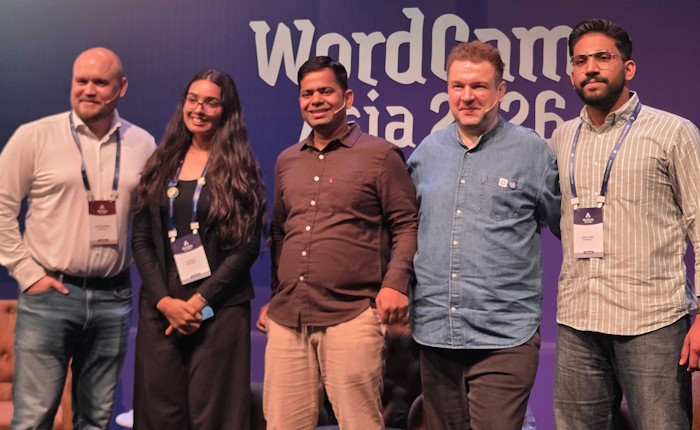
He was even invited to join the stage during a panel discussion, which is not a small detail in this story as it shows how quickly a student can move from observer to participant when the environment makes that possible.
“Standing there, sharing my journey as a student, in front of such an engaged audience… it didn’t feel real for a second.
Because I kept thinking. This all started with a simple page builder assignment.
And what made it even more powerful was the audience. People were not there because they had to be. They actually cared. They listened. Properly. Every talk had attention, interest, energy.
You could feel it.”
Where and how WPBakery fits in
This is also where WPBakery’s role becomes more than just background support. In our original announcement about joining WordPress Credits, we were clear that the goal was not product promotion as students are not expected to use WPBakery plugin. The license is there as an option, without pressure, as part of making professional site-building workflows more accessible during the learning process. More importantly, our involvement is about supporting how people enter WordPress in practice: through mentorship, through real exposure and through the kind of backing that helps participation feel possible instead of distant. And, by having Kenny with us at WordCamp Asia 2026, we take pride in having a small part in helping him shaping his thesis while also showing what can happen when support is not abstract.
What comes next?
The next step in this process is WordCamp Europe 2026 in Kraków, where WPBakery is sponsoring Kenny’s trip as part of supporting the continuation of his work which enables the next stage of the research by making it possible to observe participation in a new event environment. He will speak with attendees and test how factors like distance, belonging, motivation and event experience influence whether people join in or stay on the sidelines.
As time goes on and we learn more and more about WP Credits through participation and contribution one thing is getting more and more clear. This initiative matters because it creates a straight path into WordPress. At the same time, these paths only matter if people can actually move through them which maker Kenny’s thesis a strong example of what that can look like when education, mentorship and ecosystem support come together in a practical way. One more thing worth noting is that participation does not only grow based on people’s interest, but also when the barriers become easier to understand and easier to reduce. All which can happen the more people and businesses start supporting WordPress Credits and other educational initiatives.
In conclusion
Hopefully, this article shed more light into educational efforts, their role within WordPress and how, by being active participants and contributors, ultimately, we all benefit from it. With that in mind, we invite you to come to WordCamp Europe and experience what we talked about first hand and maybe consider joining any of the Learn WordPress initiatives.
