Do I still need a WordPress theme in 2026 (and in 2027 too)?
With the AI revolution taking place right before our eyes, I see developers questioning the tools and solutions they have used for years: “Can AI replace them? Can I just vibe-code what I need?” The same conversations are happening in the WordPress space. I was part of quite a few of them at WordCamp Asia in Mumbai last month, including whether the WordPress themes, which have served us well for over a decade, are still relevant.
In answering this question I’ll touch on both the technical and business aspects as I make the case that they are and will remain relevant.
Just to be clear, I’m talking about themes as a way to package a design, layout, and functionality – which is what you get when you download one from the WordPress Theme Directory or a marketplace like Themeforest. I’m not making a distinction between classic and full-site editing themes either.
Before I start, let me share what Svilena Peneva, Head of Partnerships at WPEngine, thinks.
As AI changes how websites are built, WordPress themes remain important because they provide the trusted foundation for design consistency, performance, accessibility, and long-term site management.
– Svilena Peneva
I couldn’t agree more, and I make the case that AI agrees with this idea too.
Can AI make WordPress work without a theme?
Technically, no. Not at this point, anyway. They are part of WordPress’ architectural foundation, so unless that changes themes aren’t going anywhere.
That said, we have starter themes that aren’t much more than a blank canvas that you then develop into the website that you need.
But it’s entirely possible that the theme paradigm is replaced by some kind of AI engine that creates a framework of sorts on the fly. We’re seeing new CMSs do just that, “headlessly”, plugging into Claude, ChatGPT, or Cursor. This is an interesting solution, but there are some ‘cons’ with this approach too:
- Themes have been central to the success of the WordPress ecosystem.
- One of WordPress’ unique selling points is portability. Switching to a different theme is central to that capability
- AI would create a website based on code it has learned… somewhere. How much control would you have over the output?
I would also keep an eye on what the AI naysayers are saying, arguing that the bubble will burst and many of the amazing tools we are using now will either become very expensive or disappear.
Of the points above, the third one is particularly interesting. Let me explain.
WordPress Themes are great teachers for AI
If AI coding tools are powered by LLMs (Large Language Models) trained on vast amounts of code, documentation, and examples from across the web, can they be trained from a theme?
I asked ChatGPT.
Yes. Modern AI coding tools can absolutely use both:
- their pretrained knowledge (patterns learned from millions of public code examples), and your supplied codebase (like a WordPress theme, plugin, framework, or coding standard)
- to generate new code that matches the style, architecture, conventions, and patterns of the supplied example.
That’s now one of the most useful real-world applications of coding AI.
In practice, this means an AI can:
- Follow your theme’s naming conventions
- Reuse your existing helper functions/classes
- Match coding style and structure
- Respect your folder architecture
- Extend existing components consistently
- Generate new modules that “feel” like the original codebase
- Learn project-specific patterns during the session/context window
The “In practice, this means an AI can” list looks exactly like the process you’re after, as opposed to letting AI base its output on what it has learned in the wild.
Which brings me to a key point: A well-coded WordPress theme following best practices, that uses clean, semantic code, a defined and consistent color palette, and a logical and structured information architecture, provides AI a solid framework to produce outputs that are just as good. In short, a well-crafted WordPress theme acts like a design system for AI.
And it’s not just about the code. Designers package style, branding, UI consistency and a great UX. The last thing for your clients is that you deliver this:
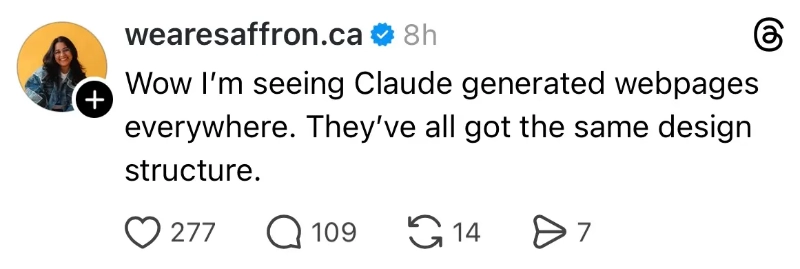
I think ‘design system’ is a great way of explaining what a WordPress theme should be to an LLM. An idea that also implies that developers and designers create ‘LLM optimized’ themes too.
The role of WPBakery in the themes of the future
Earlier in this piece I stated that themes have been central to the success of WordPress. They still are – 1,000+ new ones were added to the Theme Directory just in the last six months. This is a reflection of demand, and just as importantly, the scale of the project.
If anything, AI is going to help developers create themes faster and to a better standard. Which, incidentally, is part of our strategy: we’re not going to develop tools that replace developers, but ones that help create better WPBakery-powered websites.
Ironically, WPBakery’s job is to hide the theme from the end user. A content author, for example, logs into WordPress, creates a new page with its unique layout, adds content, and publishes it. Easy. At no point do they have access to the header, footer, or the underlying grid system keeping the website together. There’s never the risk of breaking a layout.
Which brings me to a point that I find myself often clarifying:
WPBakery is not a theme builder, nor is it a “site builder – it’s a powerful drag-and-drop interface for non-developers to manage content easily. It’s compatible with whatever system or workflow WordPress developers use to build a WordPress theme because… it’s not that system or tool. Whatever the tooling – whether an IDE or a chat prompt – WPBakery fits into the solution to help content authors, editor, Marketer, admin, etc… get their work done faster and painlessly. Without having to learn CSS.
I can also argue that WPBakery is compatible with the themes of the future given our track record of being backward compatible. Unlike many other page builders, you just don’t see posts stating “WPBakery breaking my website” on social media. Again, this is part of a product strategy that is 15 years in the making.
What about developers? They are already fully invested in AI and producing better work faster for it. WPBakery is boosting that workflow too.
Using WPBakery Page Builder has allowed us to cut development time by approximately 40 – 60% compared to building custom layouts from scratch using raw HTML/CSS or even coding custom Gutenberg blocks in WordPress.
You can read the case study for additional context – Case study: How Seahawk Media cut development time by 50% with WPBakery.
AI is great at powering up workflows but not replacing them. If the scope is broad and undefined, you get slop-creep. If its use is more targeted and specific, it becomes very accurate and effective. But the point is the theme provides AI the context – the design system – to produce the quality of output that is needed.
A common use case is to use AI to create WPBakery custom content elements. Here are two examples we wrote about:
- How to Create Custom WPBakery Elements Using AI
- How to add Halloween effects to your WordPress site using WPBakery
Concluding thoughts
Themes are like SSH. They have been around a long time, are tried and tested, and serve their purpose well.
But there’s more. They are a design system for AI to better understand the code, site architecture, branding and image styles, and output better code and artefacts.
So yes, you will still need a WordPress theme in 2026 and 2027. In fact, the argument that themes make AI work better is strong.
